Blog · 23 November 2026
Wheelchair stair lifts: platform lifts, through-floor lifts and stair climbers
If you use a wheelchair and your home has stairs, a standard seated stairlift isn't always the answer: you have to move out of your chair and onto the seat, and you need a second chair at the top. There are other options – a platform stairlift that carries the wheelchair, a through-floor lift, or a stair-climbing wheelchair or stair climber.
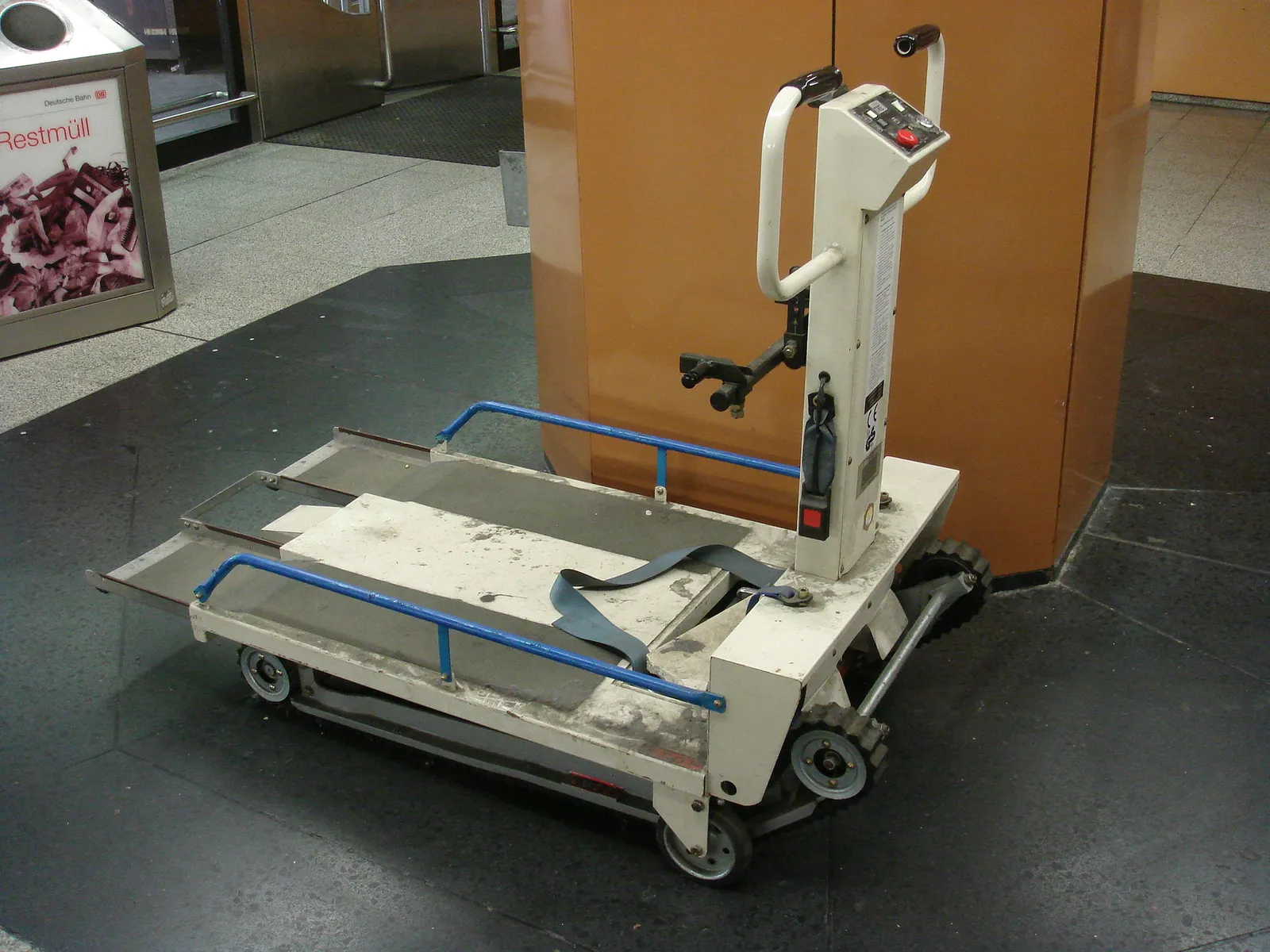
This post sets out how the options differ and what the official sources say about assessments, council grants and VAT, as of 23 November 2026. Our guide to stair-climbing wheelchairs goes into the climbing chairs in more detail.
The four main options
Living Made Easy, the impartial equipment information service from the Disabled Living Foundation, describes the lift types. In short:
- Seated stairlift. A chair that runs on a rail fixed to the stairs. You transfer from your wheelchair onto the seat, so you need to be able to do that safely, and you will usually need a second wheelchair upstairs. Living Made Easy says stairlifts "are usually cheaper to install than through floor lifts, as building alterations are not normally required."
- Platform (wheelchair) stairlift. A platform on a rail that carries you in your wheelchair. Living Made Easy says these "eliminate the need to transfer out of a wheelchair and onto a stairlift", but warns that they take up a lot of room on the stairs and many domestic staircases are too narrow for them.
- Through-floor lift. A lift car that travels between two floors through an opening in the ceiling. Living Made Easy says that if you use a wheelchair you can avoid the need to transfer in and out of your chair, and that lifts without a shaft need fewer structural alterations, so may suit a home better.
- Stair-climbing wheelchair or wheelchair stair climber. Nothing is fixed to the building. A stair-climbing powerchair, such as the XSTO X12, climbs the stairs with you seated in it; a stair climber such as the XSTO TR250T carries a manual wheelchair up and down with a trained helper operating it. Both have limits on step height, stair angle and landing space.
Official source: Living Made Easy: lifts (opens in a new tab)
Start with an assessment
For anything fixed to your home, start with your council. The NHS says you can ask social services for an assessment for equipment or home adaptations, by phone or online, and that "Having a home assessment is free." Its list of example adaptations includes "fitting a stairlift or a banister on the stairs".
Living Made Easy says an assessment with an occupational therapist is "strongly recommended" before choosing a stairlift and its features. An occupational therapist can look at how you transfer, how your needs may change and which option suits your stairs and rooms.
The NHS also says your council should pay for each adaptation that costs less than £1,000. Lifts usually cost more than that, which is where a grant comes in.
Official source: NHS: home adaptations (opens in a new tab)
Disabled Facilities Grants
A Disabled Facilities Grant (DFG) from your local council can help pay for changes to your home. GOV.UK's examples of work it can cover include improving "access to rooms and facilities, for example with a stairlift, or level access shower", and building an extension such as a downstairs bedroom, which can be an alternative to a lift.
Our guide to adapting your home for a powered wheelchair explains who can apply, how the means test works and the maximum amounts, and why you shouldn't start the work before the council approves the grant.
Official source: GOV.UK: Disabled Facilities Grants (opens in a new tab)
VAT on lifts
HMRC's VAT Notice 701/7 lets an eligible disabled person buy "a stair lift or a chair lift designed for use in connection with a wheelchair" without VAT, and says the lift doesn't have to carry the person while they are sitting in the wheelchair. The notice also allows zero-rating of the installation and repair of a lift for a disabled person where it is designed to help that person move between floors of their own home.
People aged 60 or over who don't qualify as disabled can get a reduced rate of VAT on items including stair lifts, but HMRC says this applies only when the supplier both supplies and installs the item.
The supplier decides whether the relief applies and will usually ask you to sign a declaration. Our VAT relief guide explains how it works for wheelchairs and other equipment.
Official source: HMRC: VAT Notice 701/7 (opens in a new tab)
Questions to ask before you choose
- Can you transfer safely, now and in future? If not, a seated stairlift may not suit you.
- Are your stairs wide enough for a platform lift, or for a stair-climbing chair to turn on the landing? Get them measured.
- Do you rent? You will need the landlord's permission for anything fixed; a stair-climbing chair needs no building work, but check it suits your stairs.
- Who will operate it? A wheelchair stair climber needs a trained helper every time.
- What happens in a power cut or if the battery runs low? Ask the supplier how each option behaves and how servicing works.
Stair-climbing chairs from XSTO
If a fixed lift isn't possible, or you need to manage steps away from home too, a stair-climbing chair may be worth a demonstration on stairs like yours. These are the XSTO models listed for stairs:
Stair-climbing mobility robot
XSTO X12
A stair-climbing, all-terrain mobility robot that keeps its seat level.
- Maximum load
- 136 kg user plus luggage
- Weight
- 115 kg without batteries
- Quoted range
- 35 km on flat ground
- Top speed
- 12 km/h about 7.5 mph
Good for:
- Stairs
- Outdoors
- Rough ground
- At home
Stair-climbing mobility robot
XSTO X12 Pro
The stair-climbing X12 with a powered, elevating legrest.
- Maximum load
- 136 kg user plus luggage
- Weight
- 116 kg without batteries
- Quoted range
- 35 km on flat ground
- Top speed
- 12 km/h about 7.5 mph
Good for:
- Stairs
- Outdoors
- Rough ground
- At home
Stair climber for manual wheelchairs
XSTO TR250T
A tracked stair climber that carries a manual wheelchair and its user up and down stairs.
- Maximum load
- 130 kg user, wheelchair and luggage together
- Weight
- 56 kg with battery
Good for:
- Stairs
- At home
No UK seller listing found (September 2026)
Sources we checked
Checked 23 November 2026. Links open the original page in a new tab.
Related reading
- Stair-climbing wheelchairs explainedHow stair-climbing wheelchairs and wheelchair stair climbers work, what your stairs need, safety questions…
- Adapting your home for a powered wheelchair: grants, storage and chargingHow Disabled Facilities Grants can pay for ramps, wider doors and other changes at home, who can apply, and…
- VAT relief on wheelchairs and mobility equipmentWho can buy a wheelchair or mobility scooter VAT-free in the UK, why class 3 scooters are treated…
- Insurance, warranty and maintenance for powered wheelchairsDo you need insurance for a powered wheelchair? Plus warranty terms for XSTO chairs, your consumer rights…