Guide · Updated September 2026
Stair-climbing wheelchairs explained
For many wheelchair users, a single flight of stairs decides where they can live, work and visit. Stair-climbing technology offers another route alongside stairlifts, through-floor lifts and ramps - but it only works if the machine, the stairs and the user are a good match.
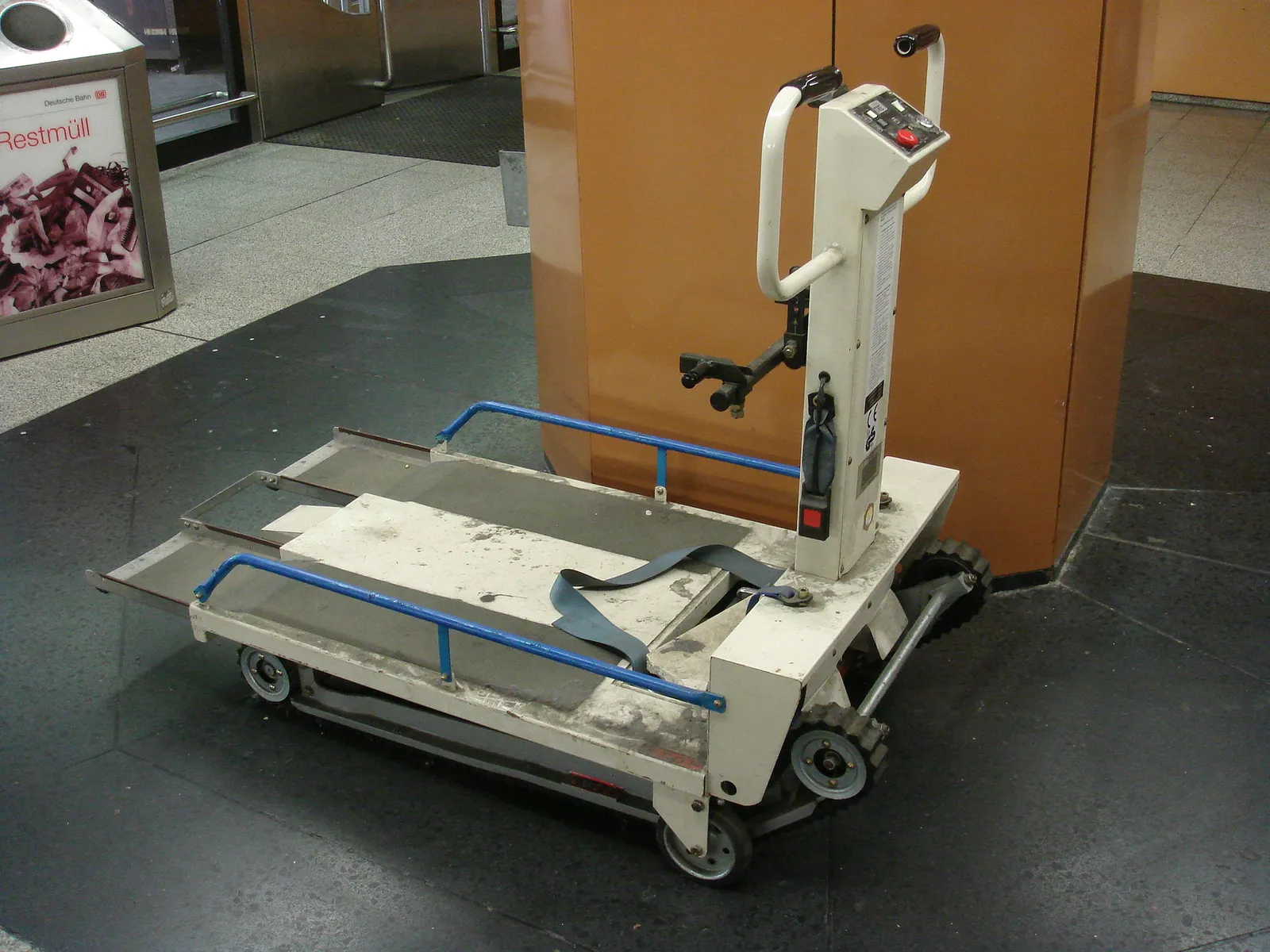
This guide explains the two main approaches, using XSTO's X12 and TR250T as examples.
Two different approaches
A stair-climbing powerchair, like the XSTO X12, is a complete wheelchair that can drive itself up and down stairs with you seated in it. A wheelchair stair climber, like the XSTO TR250T, is a separate tracked carrier: you stay in your own manual wheelchair, which is secured onto the unit, and a helper guides it up or down the stairs.
A stairlift is fixed to one staircase. Stair-climbing equipment is portable, which can suit rented homes, shared stairs or places you visit - but it asks more of the user or helper each time.
How the XSTO X12 climbs
XSTO describes the X12 as combining four wheels with twin tracks. On flat ground it drives on its wheels; at stairs and kerbs it uses a hybrid wheel-and-track mode; and a full track mode handles wide gaps and step-like obstacles. Sensors are used to recognise steps, switch modes, adjust power and correct its line on the stairs, while the seat levels itself.
XSTO quotes 25 steps a minute going up and 30 going down.
Official sources: XSTO X12 (opens in a new tab)XSTO X12 Pro (opens in a new tab)
How the XSTO TR250T works
The TR250T carries a manual wheelchair with 20 to 25 inch wheels up and down stairs on non-slip tracks at 21 steps a minute. Its 130 kg limit includes the user, the wheelchair and any luggage. It has an emergency stop and a balance line to show the operator when to switch between stair and level modes.
Official source: XSTO TR250T (opens in a new tab)
Will your stairs work?
Every stair-climbing product has limits on step height, stair angle and landing space. Get your stairs measured before you order, and ask the supplier to demonstrate on stairs like yours.
- X12: steps under 200 mm high, stairs under 35°, landings of 1400 × 1400 mm for an L-turn or 1400 × 2000 mm for a U-turn
- TR250T: steps up to 180 mm, stairs up to 35°, landings of 1100 × 1400 mm for L-shaped or 2200 × 1400 mm for U-shaped stairs
- Check handrails, the surface of the treads, and space at the top and bottom
- Think about how you will get out of danger if the machine stops part-way
Safety questions to ask
Ask the supplier what training they provide and whether they will assess your stairs in person. Ask what happens if the battery runs low mid-flight, how the emergency stop works, and who in your household will be trained. Follow the manufacturer's instructions exactly, and do not try stairs outside the published limits.
Costs and VAT
Stair-climbing products are expensive. HMRC guidance says a stair lift or chair lift designed for use with a wheelchair can be bought VAT-free by an eligible person, and that wheelchairs qualify too. For faster powered chairs, HMRC's rules on class 3 vehicles apply. The supplier decides whether VAT relief applies to a specific product.
Official source: HMRC: VAT relief on certain goods (opens in a new tab)
Questions
Can I use a stair-climbing wheelchair on my own?
The X12 is designed to be driven by the person sitting in it. The TR250T is designed to be guided by a helper. In both cases, get training and follow the manufacturer's instructions.
Can a stair-climbing chair handle spiral stairs?
XSTO publishes limits on step height, stair angle and landing space for its products. Ask the supplier to assess your staircase in person rather than relying on general claims.
Is a stair climber cheaper than a stairlift?
It depends on the product and the staircase. Get quotes for the options that suit your home, and factor in training, servicing and the space each needs.
Sources we checked
Information checked September 2026. Links open the original page in a new tab.
More guides
- Class 2 and class 3 powered wheelchairs: the UK rulesWhat the class of a powered wheelchair means in the UK: speed limits, pavements and roads, DVLA…
- How to choose a power wheelchairA practical, plain-English guide to choosing a powered wheelchair in the UK: assessments, where you will use…
- Insurance, warranty and maintenance for powered wheelchairsDo you need insurance for a powered wheelchair? Plus warranty terms for XSTO chairs, your consumer rights…
- NHS wheelchair services and help with fundingHow NHS wheelchair services work across the UK, personal wheelchair budgets in England, the Motability…