Guide · Updated November 2026
Buses, coaches and taxis with a powered wheelchair: your rights
Local buses, coaches and taxis can make a powered wheelchair far more useful, but whether you get on can depend on the size of your chair and on knowing what drivers have to do. This guide sets out what the official guidance says for Great Britain.
It is based on Department for Transport guidance on GOV.UK as of November 2026. Operators' own policies can add to these rules, so check with the bus, coach or taxi company too. Our travel guide covers trains, flights and cars.
What the bus and coach rules cover
The accessibility rules for buses and coaches are set out in the Public Service Vehicles Accessibility Regulations 2000, often called PSVAR. GOV.UK's guidance applies in England, Scotland and Wales and covers single-deck and double-deck buses and coaches.
The rules apply to wheelchairs, including electric wheelchairs, but not to mobility scooters. They do not apply to minibuses or other vehicles carrying 22 passengers or fewer, or to private or hired buses and coaches that do not run to a timetable.
Official source: GOV.UK: buses and coaches for disabled people (opens in a new tab)
Will your chair fit?
The rules are built around a standard wheelchair that is 70 cm wide, 120 cm long and 1.35 m high. A bus must have at least one space for a wheelchair of that size, with an aisle wide enough to reach it from the entrance.
On XSTO's published unfolded figures, the M4 (580 mm wide, 1035 mm long), M4 Pro (592 × 1120 mm) and M8 (610 × 1085 mm) are inside the standard width and length. The M8 Pro (1235 mm) and the X12 and X12 Pro (1210 mm) are longer than 120 cm, so a driver may be entitled to refuse them, and you should check with the operator before relying on a bus. Measure your own chair as you would travel in it.
Official source: GOV.UK: standard wheelchair size (opens in a new tab)
The wheelchair space, ramps and help
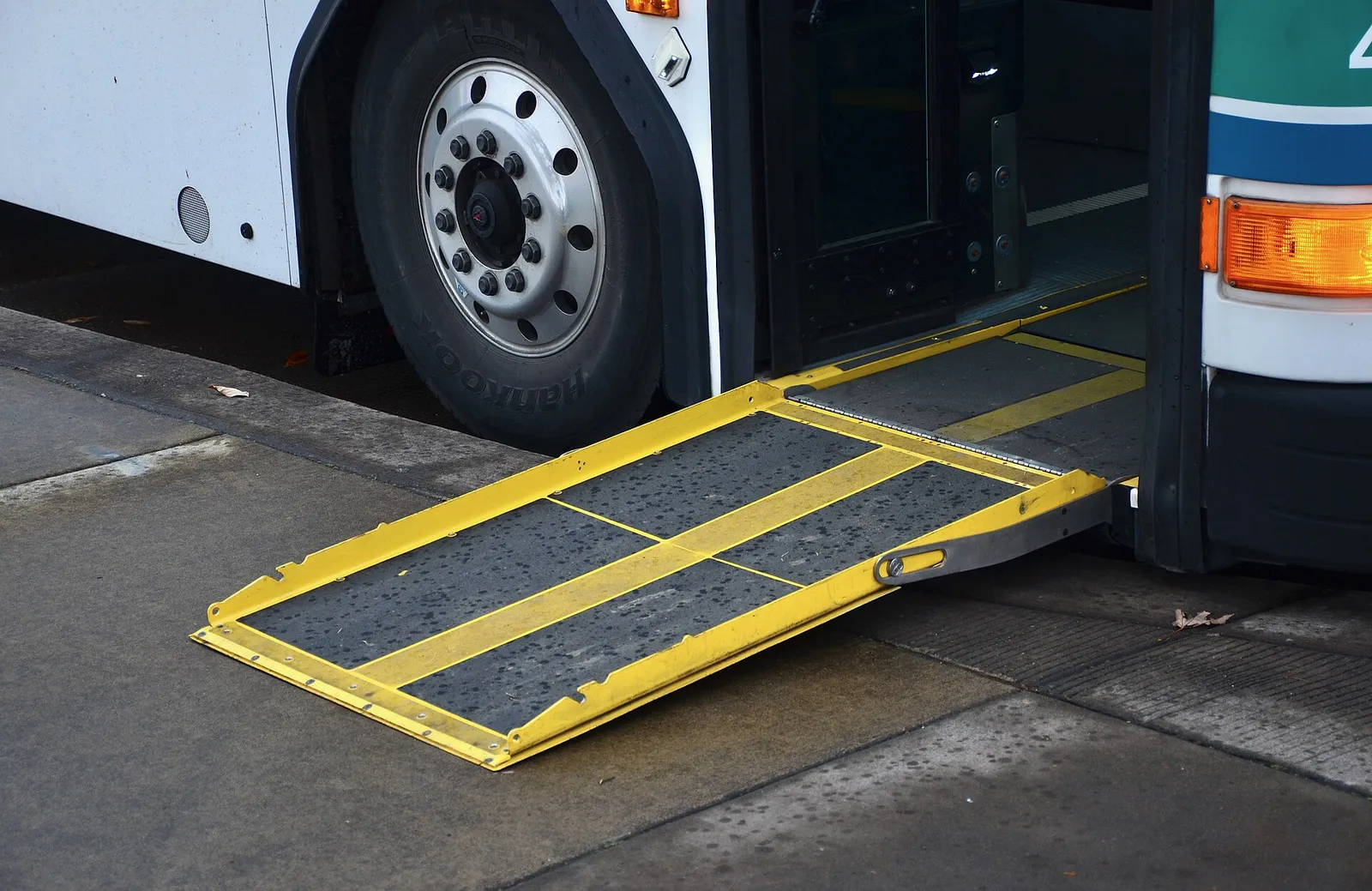
The wheelchair space must face forwards or backwards. A forward-facing space needs a restraint, similar to a seat belt. Any seats in the space must fold or be removable, with a sign asking passengers to give them up for a wheelchair user. The bus must have a working lift or ramp, and the driver must check it is safe before using it.
Drivers must help disabled passengers get on and off if asked, and offer help with the wheelchair restraint. They do not have to lift passengers or heavy mobility equipment, and can hold back help if they reasonably believe there is a risk to health, safety or security.
Official source: GOV.UK: wheelchair spaces and driver help (opens in a new tab)
When a driver can refuse you
GOV.UK says a driver can only refuse to let a wheelchair user on for these reasons:
- The wheelchair is larger than the standard wheelchair
- It cannot be safely placed in the wheelchair space
- Letting you on would take the bus over its seating or standing capacity
- Another wheelchair user is already in the space
Official source: GOV.UK: when a driver can refuse (opens in a new tab)
If someone else is in the space
If the bus is not full, the driver must ask other passengers to move out of the wheelchair space, and if they refuse without good reason, tell them they are required to move. Drivers have no legal power to move them physically. GOV.UK says operators' policies may include holding the bus where that would not delay other passengers, or arranging and paying for other transport such as a taxi, so it is worth knowing your operator's policy.
Official source: GOV.UK: other passengers in the space (opens in a new tab)
Coaches
GOV.UK advises asking for help getting on and off when you book a coach ticket. Coach seats must have armrests that move so disabled passengers can reach them easily. Some coaches used for home-to-school services do not have to meet all the rules until 10 August 2030.
Official source: GOV.UK: transport if you're disabled (opens in a new tab)
Free bus travel
Disabled people can get a bus pass for free travel. In England you apply to your local council, and GOV.UK says English passes can be used anywhere in England at any time on Saturdays, Sundays and bank holidays, and from 9:30am to 11pm on other days. Scotland, Wales and Northern Ireland run their own schemes, linked from the GOV.UK page.
Official source: GOV.UK: apply for a disabled bus pass (opens in a new tab)
Taxis and minicabs
GOV.UK says it is against the law for a taxi or minicab driver to refuse a journey, or for an operator to refuse a booking, because you are disabled. A driver or operator who refuses when a vehicle is available could be fined up to £1,000 or lose their licence. Drivers must help you get in and out, stow your mobility aid and find the vehicle, and cannot charge extra for that help. Minicabs (private hire vehicles) must be booked in advance.
Not every taxi can take a powered wheelchair. Councils must keep and publish a list of wheelchair-accessible taxis and private hire vehicles in their area. The Department for Transport's guidance says a vehicle can be on the list if it carries some, but not necessarily all, types of wheelchair, measured against the same standard wheelchair of 700 × 1200 × 1350 mm, and that powered wheelchairs and mobility scooters may not fit some listed vehicles. When you book, give the chair's dimensions and weight and ask for a vehicle that can take it.
Drivers with a medical condition can be given an exemption from the physical help, such as lifting a mobility aid into the boot. They must display an exemption notice in the vehicle, and the other duties - including not charging extra - still apply.
Official sources: GOV.UK: your rights in taxis and minicabs (opens in a new tab)DfT guidance on taxi access (opens in a new tab)
If something goes wrong
For buses and coaches, complain to the operator first. GOV.UK says you can also report problems to the Driver and Vehicle Standards Agency (DVSA), and if the company does not sort it out, contact Bus Users UK outside London or London TravelWatch in London. For bus pass problems, the route is your local government ombudsman. For taxis and minicabs, report problems to your council's taxi licensing office.
Official source: GOV.UK: complaints (opens in a new tab)
Questions
Does the bus wheelchair space rule cover mobility scooters?
No. GOV.UK says the bus and coach rules apply to wheelchairs and electric wheelchairs, not mobility scooters. Some operators carry scooters under their own policies, so ask them.
Can a bus driver refuse my powered wheelchair?
Only for set reasons: it is larger than the standard 70 × 120 cm wheelchair, it cannot be safely placed in the space, the bus is full, or another wheelchair user is already in the space.
Can a taxi charge me more because I use a wheelchair?
No. GOV.UK says drivers cannot ask you to pay extra for helping you, including stowing a mobility aid, and the Department for Transport guidance says drivers of wheelchair-accessible vehicles must not charge extra for carrying you in your wheelchair.
How do I find a taxi that can take my chair?
Ask your council's taxi licensing office for its list of wheelchair-accessible vehicles, and give the chair's dimensions and weight when you book.
Do these rules apply in Northern Ireland?
The GOV.UK bus guidance and the Department for Transport taxi guidance cover England, Scotland and Wales. In Northern Ireland, check nidirect and the operator.
Sources we checked
Information checked November 2026. Links open the original page in a new tab.
- GOV.UK: Buses and coaches - features and help for disabled people
- GOV.UK: Transport if you're disabled
- GOV.UK: Apply for a disabled person's bus pass
- GOV.UK: Access to taxis and private hire vehicles for disabled users
- XSTO M4 / M4H in the XSTO store
- XSTO M4 Pro in the XSTO store
- XSTO M8 (manufacturer page)
- XSTO M8 Pro (manufacturer page)
- XSTO X12 (manufacturer page)
Related reading
- Changing Places toilets: what they are and how to find one on a day outA standard accessible toilet isn't enough for many powerchair users. What a Changing Places toilet has…
- Christmas train travel with a powerchair: Passenger Assist, Railcards and what to checkVisiting family by train this Christmas? How to book Passenger Assist (and the two-hour minimum), turn up…
- Shops, cafés and other services: your rights as a powerchair userWhat the Equality Act 2010 means when a shop, café, venue or other service is hard to use in a powered…
- Buying a powerchair or accessories in the sales: your rights in plain EnglishBlack Friday and the January sales can be a good time to buy kit, but it pays to know the rules first: the…
- Buying a second-hand powered wheelchair: checks and your rightsWhat to check before buying a used powerchair, your rights when buying from a business or a private seller…