Guide · Updated September 2026
Class 2 and class 3 powered wheelchairs: the UK rules
In law, powered wheelchairs and mobility scooters are known as 'invalid carriages', and the rules you follow depend on which class your vehicle is in. The class decides whether you can use the road, whether you must register with DVLA, and which eyesight standard applies.
This summary is based on GOV.UK and the Highway Code as of September 2026. Always check the official pages, and ask the seller to confirm your chair's class in writing.
Who can use a powered wheelchair
GOV.UK says you can only drive a mobility scooter or powered wheelchair if you have trouble walking because of an injury, physical disability or medical condition - or if you are taking it for repair, testing it as the manufacturer, demonstrating it before sale or training a disabled user. If none of these applies and you have an accident, you could face the same penalties as a car driver.
Official source: GOV.UK: who can use them (opens in a new tab)
The classes
The Highway Code describes a manual wheelchair as a class 1 invalid carriage. Powered wheelchairs and scooters fall into class 2 or class 3.
Some vehicles are not in any class. GOV.UK says that is the case if a vehicle can go faster than 8 mph, is wider than 0.85 metres, or weighs more than 150 kg (200 kg if it carries equipment you need, such as medical equipment). These can only be used on the road, need a driving licence and must be registered with DVLA.
- Class 2: maximum speed of 4 mph (6 km/h); designed for pavements
- Class 3: maximum speed of 8 mph (12 km/h); equipped for the road as well as pavements; must be registered with DVLA
- Not in a class: over 8 mph, over 0.85 m wide or over 150 kg - road only, licence and registration needed
Official sources: GOV.UK: classes explained (opens in a new tab)The Highway Code, rules 36 to 46 (opens in a new tab)
On pavements
Only class 2 and class 3 vehicles can go on pavements, footpaths, bridleways and other pedestrian areas, and the maximum speed there is 4 mph. You must give way to pedestrians and drive considerately. The Highway Code tells class 3 users to switch to the lower speed setting on pavements.
Normal parking restrictions apply, and you should not leave a chair where it blocks other pedestrians, including other wheelchair users and people with pushchairs.
Official source: GOV.UK: pavements, footpaths and parking (opens in a new tab)
On the road
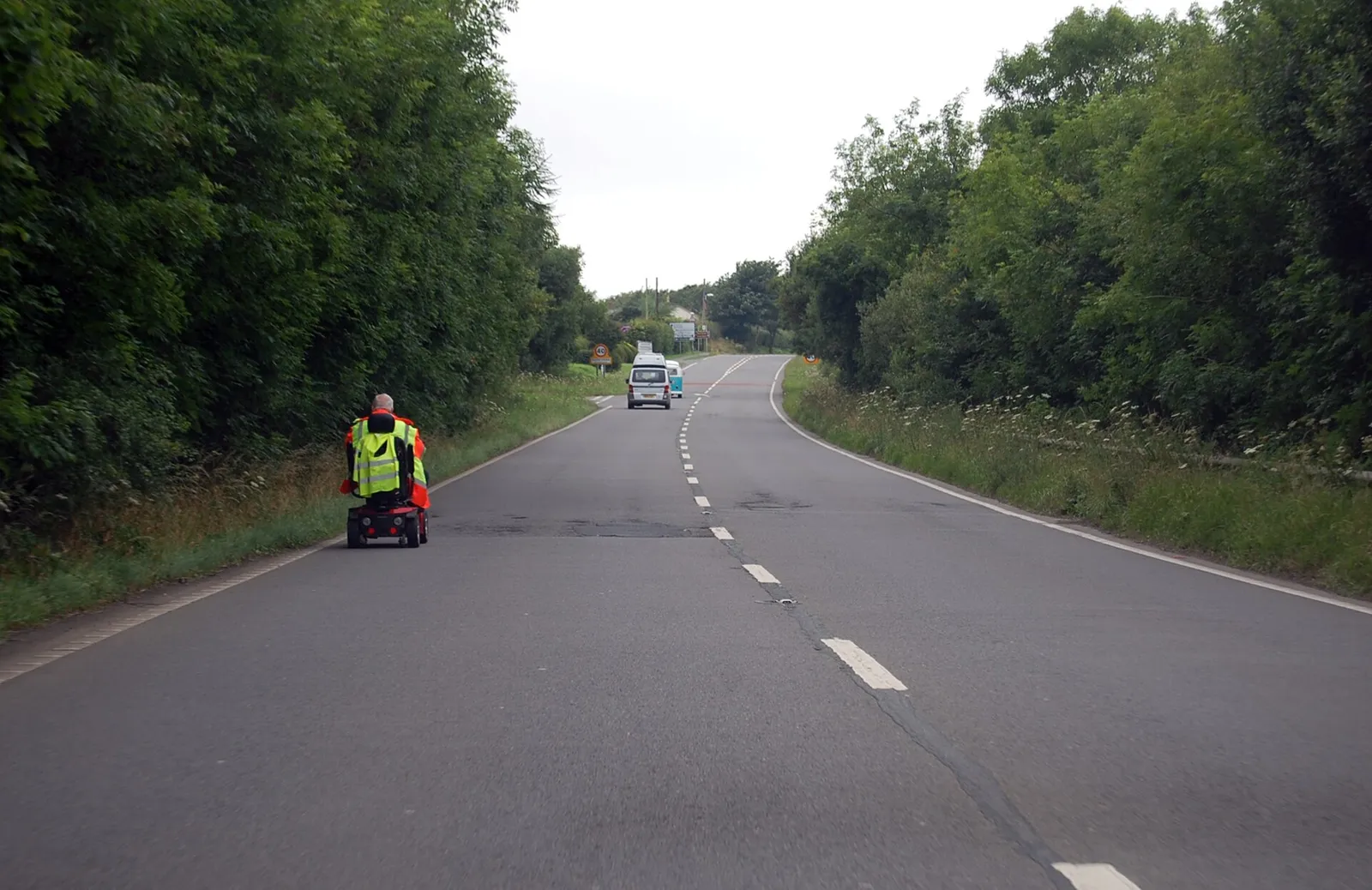
To drive on the road, a vehicle must be class 3 or not in a class. GOV.UK lists what it must have, and says you could be stopped by the police if these are missing.
- A maximum speed of at least 8 mph
- An efficient braking system
- A clear view of the road ahead
- Front and rear lights and reflectors
- Direction indicators that can work as hazard warning lights
- A rear-view mirror
- An audible horn
Official source: GOV.UK: driving on the road (opens in a new tab)
Where you cannot go
You cannot use a powered wheelchair on motorways, in bus lanes or in cycle lanes painted on the road. Class 2 and 3 vehicles can use cycle tracks that are separated from the road. GOV.UK says to avoid dual carriageways with a speed limit over 50 mph, and you must use a flashing amber light if you do use one; the Highway Code also recommends an amber light on other dual carriageways.
Official source: Highway Code rules 36 to 46 (opens in a new tab)
Registration, tax and insurance
Class 3 vehicles, and those not in a class, must be registered with DVLA. There is no vehicle tax to pay if it is registered as a mobility scooter or powered wheelchair. GOV.UK says the dealer will usually register a new vehicle for you; if not, you can use form V55/MV and should receive a log book (V5C) within four weeks.
Insurance is not a legal requirement for class 2 or class 3 vehicles, but GOV.UK recommends it. A vehicle that is not in a class must be insured if its total weight is over 254 kg.
Official source: GOV.UK: tax, registration and insurance (opens in a new tab)
Eyesight
For class 2 and class 3 vehicles, GOV.UK says you should be able to read a car number plate from 12.3 metres (40 feet). For vehicles not in a class the standard is 20 metres (65.5 feet). You can be prosecuted if you have an accident because of poor eyesight.
Official source: GOV.UK: eyesight requirements (opens in a new tab)
What about XSTO chairs?
In the material we read, XSTO does not state a UK class for any of its chairs, so we do not assign one. What the published figures do show is this: the M4 and M4 Pro have a quoted top speed of 6 km/h, and the M8, M8 Pro and X12 series go up to 12 km/h. A chair capable of more than 4 mph still has to be kept to 4 mph on pavements.
If you are buying in the UK, ask the seller to confirm in writing which class the chair is supplied as, whether it needs DVLA registration, and - for road use - whether it has every item on the GOV.UK list.
Northern Ireland
The Highway Code for Northern Ireland has equivalent rules 36 to 46 for powered wheelchairs and scooters, including the same 4 mph and 8 mph class limits.
Official source: Highway Code for Northern Ireland (opens in a new tab)
Questions
Can I use a class 2 chair on the road?
The Highway Code says class 2 users should always use the pavement when one is available. Where there is no pavement you may use the road with care, travelling in the direction of traffic where possible.
Do I need a driving licence for a class 3 powered wheelchair?
GOV.UK says a driving licence is needed for vehicles that are not in a class. For class 3 it requires DVLA registration rather than a licence.
Do I have to insure my powered wheelchair?
Not for class 2 or class 3, although GOV.UK recommends it. Vehicles not in a class must be insured if their total weight is over 254 kg.
Who tells me what class my chair is?
GOV.UK says the seller or manufacturer can usually tell you. If they cannot, you can work it out from its speed, width and weight.
Sources we checked
Information checked September 2026. Links open the original page in a new tab.
- GOV.UK: Using mobility scooters and powered wheelchairs
- GOV.UK: Classes of mobility scooter and powered wheelchair
- GOV.UK: Driving on the road
- GOV.UK: Driving on pavements, footpaths and bridleways
- GOV.UK: Eyesight requirements
- GOV.UK: Vehicle tax, registration and insurance
- The Highway Code: rules 36 to 46
- Highway Code for Northern Ireland: rules 36 to 46
- XSTO M4 (manufacturer page)
- XSTO M4 Pro (manufacturer page)
- XSTO M8 (manufacturer page)
- XSTO X12 (manufacturer page)
More guides
- How to choose a power wheelchairA practical, plain-English guide to choosing a powered wheelchair in the UK: assessments, where you will use…
- Insurance, warranty and maintenance for powered wheelchairsDo you need insurance for a powered wheelchair? Plus warranty terms for XSTO chairs, your consumer rights…
- NHS wheelchair services and help with fundingHow NHS wheelchair services work across the UK, personal wheelchair budgets in England, the Motability…
- Self-balancing wheelchairs explainedWhat 'self-balancing' means in XSTO's powerchairs, how it helps on slopes, its limits, and how the M4, M4…